 De bridge
 Cross-Chain Swap Fit and Transfer Choices
De bridge cross-chain swaps suit transfers that require a particular token on another network. The choice depends on whether the available route delivers the asset, amount, and destination that the task requires. Solver liquidity and profitability affect whether an order is filled; a quote alone does not establish delivery. If your funds are already on the intended network, a supported same-chain swap may provide the required token. Reversibility also changes the decision. Reviewing an unsigned quote leaves the transfer uncommitted, while submitting an order exposes funds to execution and conditional cancellation. Compare the complete destination outcome before accepting that commitment.
A cross-chain swap fits when the destination asset matters, and committing funds means accepting solver-dependent fulfillment and a conditional cancellation path.
Destination Requirements Separate the Available Paths
A change of network calls for a cross-chain route, while a token conversion within the existing network can use a supported same-chain swap. Both choices require compatible assets and an executable quote. Their custody, timing, and completion conditions differ.
A Different Network and a Requested Token
The deBridge Liquidity Network, or DLN, lets an order specify the destination token and amount. Source funds enter a smart contract while a solver supplies the requested destination assets. This arrangement fits a transfer whose purpose is acquiring usable destination liquidity. It does not promise that every requested combination will attract a solver, even when an order can express it.
A Conversion on the Existing Network
A same-chain swap keeps execution on one network and completes atomically within its transaction. It suits a task that needs another token without relocating funds. Its costs include the swap and network transaction, and its output depends on the executable route and slippage settings. Completion appears in that network’s transaction record. This path cannot satisfy a requirement to receive assets elsewhere.
When Does a Transfer Stop Being Freely Reversible?
A transfer stops being freely reversible when its signed transaction is submitted for execution, because execution may proceed before a change of mind can take effect. Treat submission as the commitment point.
Quote Review Leaves the Transfer Uncommitted
An unsigned quote supports comparison without creating an order. Review the input, destination output, recipient, and transaction costs while changes remain possible. Any separate token approval has its own effect: it grants spending permission. Abandoning the proposed transfer does not itself remove that permission.
Cancellation Has Conditions and Costs
A fulfilled DLN order cannot be cancelled through the unfulfilled-order cancellation procedure. Before fulfillment, cancellation requires the designated destination authority and a destination-chain transaction. Cross-chain processing then releases the locked source funds. Cancellation therefore introduces another transaction, processing time, and associated costs; it is not equivalent to discarding a quote.
A route can also convert the original input into a reserve asset before creating the order. Cancelling that order returns the locked reserve asset rather than undoing the earlier conversion. If preserving the original token is essential until a later decision, submitting this route fails that requirement.
Comparable Outputs Make Costs Meaningful
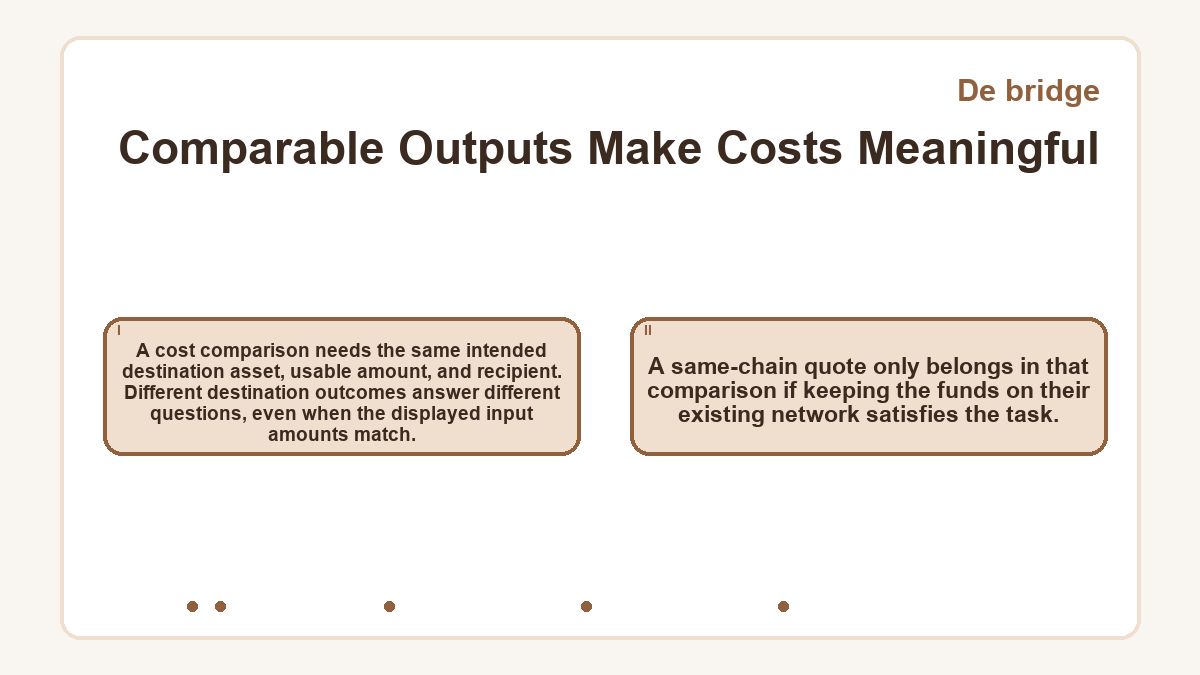
A cost comparison needs the same intended destination asset, usable amount, and recipient. Different destination outcomes answer different questions, even when the displayed input amounts match. A same-chain quote only belongs in that comparison if keeping the funds on their existing network satisfies the task.
For a cross-chain order, distinguish protocol charges from source transaction gas and the solver’s operating expenses and margin. A route may also include conversion slippage, an integration fee, or a hook execution reward. Some costs affect the quoted output; others require an additional balance. Counting an expense twice can distort the comparison just as much as overlooking it.
The useful figure is the amount of the required asset available after the selected route’s applicable costs. Keep a separate allowance for transactions that follow delivery. Receiving a token balance and having native currency to spend it are different requirements.
Does a Better Quoted Output Mean a Better Transfer?
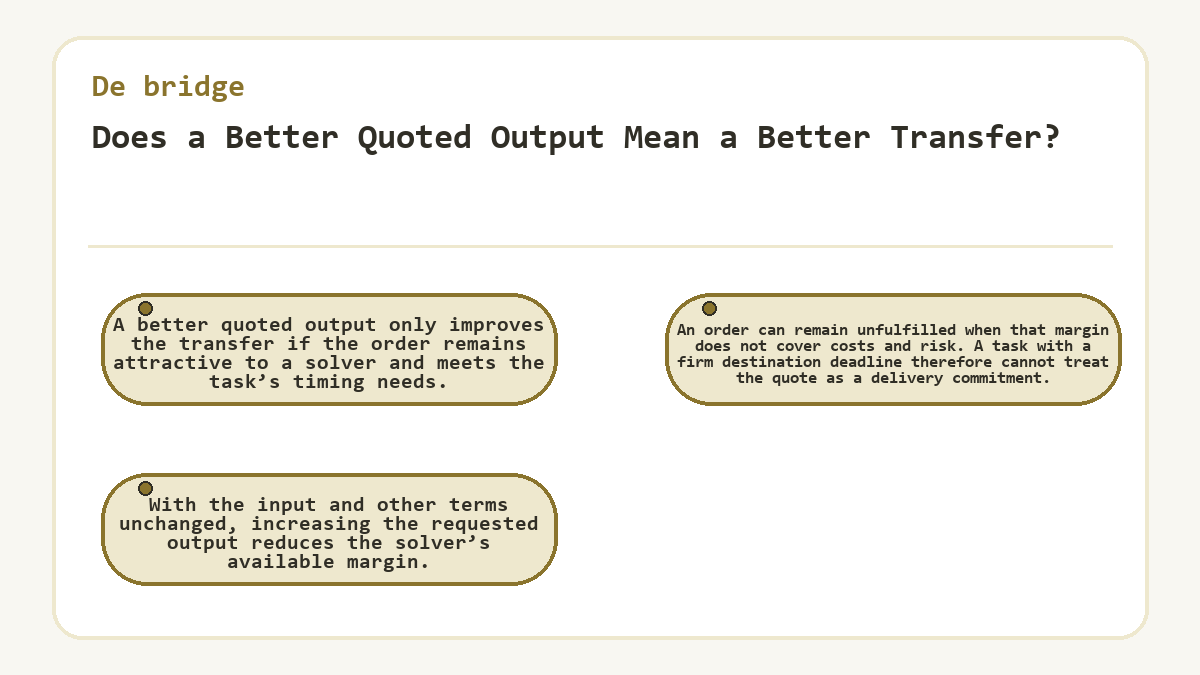
A better quoted output only improves the transfer if the order remains attractive to a solver and meets the task’s timing needs. With the input and other terms unchanged, increasing the requested output reduces the solver’s available margin. An order can remain unfulfilled when that margin does not cover costs and risk. A task with a firm destination deadline therefore cannot treat the quote as a delivery commitment.
Should You Submit the Swap or Keep the Funds Uncommitted?
Submit the swap only when its destination outcome is acceptable and you no longer need to keep the source funds freely available. Otherwise, keep the proposal unsigned while resolving the missing condition.
For a transfer requiring a different destination token, compare the available order with leaving the source balance untouched. Submission pursues delivery but commits funds under the order’s rules. Waiting preserves the balance and the ability to revise the request, but does not reserve the quote or advance the transfer.
- The quoted route supports the selected source asset and required destination token.
- The recipient can use the destination asset for the intended task.
- The received amount meets that task after applicable costs.
- The task tolerates solver-dependent timing and the order’s cancellation conditions.
- The original token no longer needs to remain freely available after submission.
If any condition remains unresolved, review the quote further or postpone the transfer. Check the route’s actual terms; network support alone does not establish that the route meets your requirements. Refreshing an estimate can change the terms that previously justified proceeding.
Once those conditions support submission, completion requires destination evidence matching the order’s token, amount, and recipient. A source debit establishes spending, not successful arrival. For a transfer without an attached action, confirm that the recipient received the requested token amount on the destination network; an unfulfilled order does not establish delivery.
Attached Actions Change What Counts as Success
A transfer intended to fund a destination operation may use a hook to attach that operation to fulfillment. This fits a task where token receipt alone is insufficient. The integration must support the intended action, and the hook configuration determines how failure affects the order.
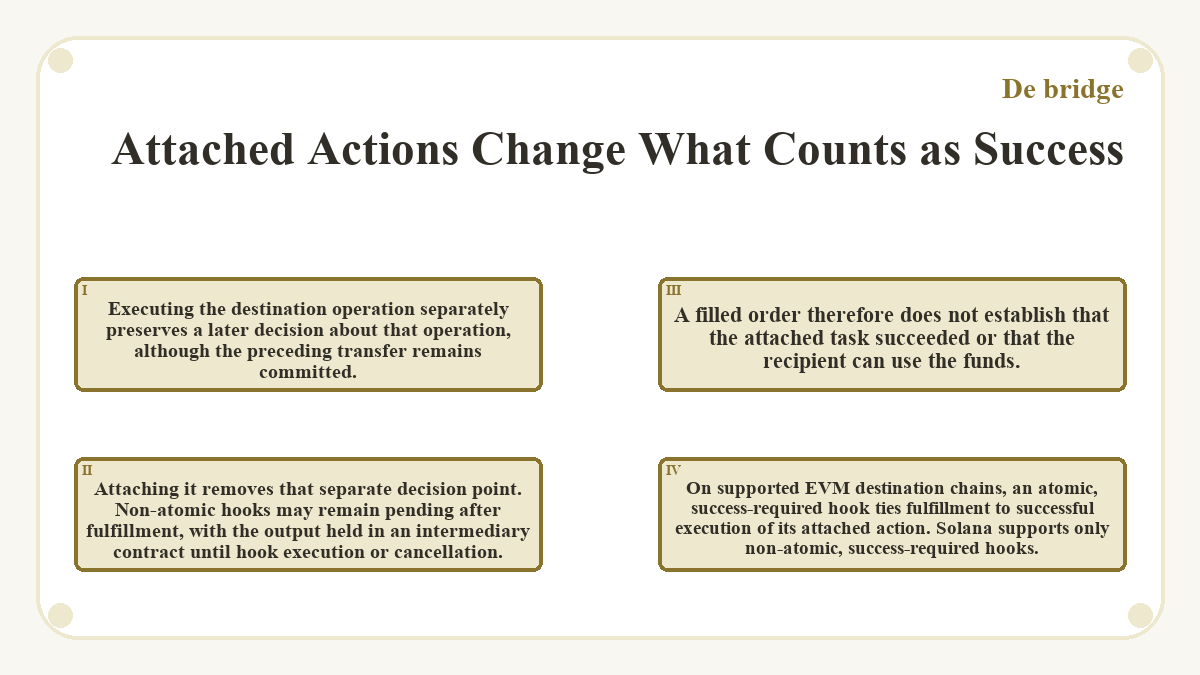
Executing the destination operation separately preserves a later decision about that operation, although the preceding transfer remains committed. Attaching it removes that separate decision point. Non-atomic hooks may remain pending after fulfillment, with the output held in an intermediary contract until hook execution or cancellation. A filled order therefore does not establish that the attached task succeeded or that the recipient can use the funds. On supported EVM destination chains, an atomic, success-required hook ties fulfillment to successful execution of its attached action. Solana supports only non-atomic, success-required hooks.
De bridge: quick answers
Can a Same-Chain Swap Before Bridging Give Me More Control Over the Conversion?
A separate source-chain swap gives you control over the conversion before the cross-chain order is created. That separation introduces its own transaction costs and leaves the subsequent transfer subject to a fresh quote. It suits a requirement to choose the source conversion independently, provided that holding the resulting asset is acceptable if the transfer is postponed.
Why Might Two Applications Show Different Quotes for the Same Transfer?
Applications can request different order terms or apply different integration fees. Quote timing also matters because conversion rates and operating expenses change. Compare the same input amount, destination token, recipient, and included costs before interpreting the difference. A larger displayed output does not establish that both applications priced the same requested outcome.
Does Matching the Token Symbol Preserve the Asset’s Transaction History?
Matching symbols do not establish that the destination tokens are the same token units sent from the source. In a DLN transfer, a solver supplies the requested destination asset while the source input settles separately. This distinction matters when the task requires a specific issuance or provenance rather than an economically similar balance. Token identity must satisfy that requirement.
How Should a Required Destination Amount Affect Quote Selection?
A required destination amount should be expressed in units of the exact token that the task needs. A displayed currency equivalent can fluctuate and does not establish that token quantity. Include any amount consumed by an attached action or its execution reward when deciding whether the proposed output is sufficient.
What Happens If I Need to Change the Recipient After Fulfillment?
Changing the recipient after fulfillment requires a separate transfer by whoever controls the delivered funds. The completed order’s cancellation path cannot redirect that delivery. A task with an undecided recipient should therefore remain unsubmitted until the destination address is settled; treating recipient selection as something to fix afterward introduces a dependency on the receiving account.